Train AI to Steal Your Writing Style (So Well It's Scary)
Most people: 'Write like me - casual and friendly!' AI: Writes like a LinkedIn influencer trying way too hard. The problem isn't AI. It's that you're describing yourself like a bad dating profile instead of showing AI who you actually are.
Graydon Trusler
Lexpert Founder
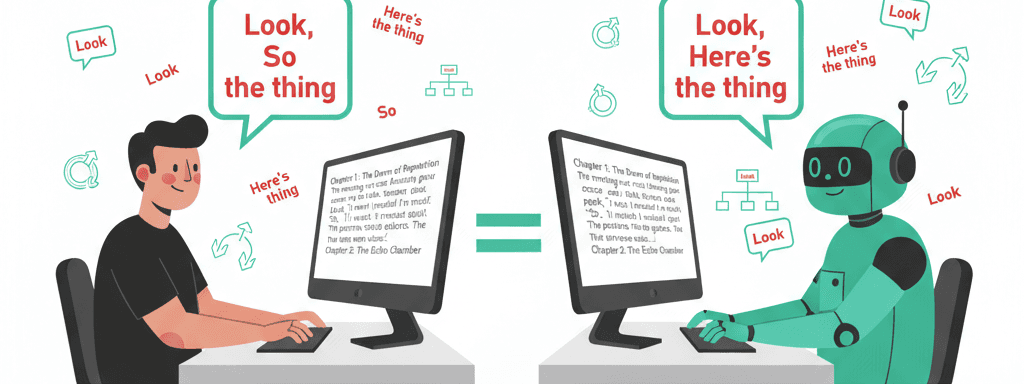
Most people: "Write like me - casual and friendly!" AI: Writes like a LinkedIn influencer trying way too hard
The problem isn't AI. It's that you're describing yourself like a bad dating profile instead of showing AI who you actually are.
The Uncomfortable Truth About Your Writing
Here's what'll bruise your ego: After all the work to capture your "unique voice," the final prompt that makes AI sound exactly like you? It's probably 3-4 sentences. Maybe 50 words. That's it.
You're not as complicated as you think. None of us are.
I spent hours analyzing my client's writing style. Fed AI dozens of examples. Built this elaborate style guide. Then realized I could capture 90% of their voice with: "Short sentences. Start with 'Look' or 'Here's the thing' a lot. One analogy per paragraph. Always sound slightly annoyed at conventional wisdom."
That was it. Their whole personality in a Post-it note.
Your writing style isn't some complex symphony. It's more like a ringtone - the same few patterns on repeat. Once you accept that, you can actually capture it.
Why Everyone Fails at This
You think you write "conversationally." You don't. You write like someone trying to sound conversational, which is different. Real conversational has typos, starts sentences with "And," and uses the same transition phrase 47 times.
You won't admit your actual patterns. Nobody wants to say "I start every third paragraph with 'The thing is...'" or "I use sports metaphors even when talking about spreadsheets." But that's exactly what AI needs to know.
You describe instead of showing. "Professional but approachable" means nothing. AI has seen a million people claim that. Show it your actual writing or accept the generic soup it serves you.
You polish your examples. Don't give AI your edited, client-ready writing. Give it your first drafts, your Slack rants, your actual voice before you made it "professional."
The Writing DNA Method
Stop describing. Start feeding.
Step 1: Gather Your Real Writing
Not your portfolio pieces. Your actual writing:
- 10 emails you sent when you were explaining something complicated
- Your Slack messages when you're slightly irritated
- That document everyone said "sounds exactly like you"
- The text you send when you're mad (yes, really)
- Your internal docs that no client ever sees
Step 2: The Mirror Exercise
Paste this exactly:
"Here are 5 examples of my actual writing. Study these for patterns in: sentence length, word choice, how I start paragraphs, my favorite phrases, how I explain things, and what I NEVER say. Tell me the 3-5 patterns that define my style."
AI will probably tell you something embarrassing like:
- You start 40% of paragraphs with "Look" or "So"
- You always use food metaphors
- You never write sentences longer than 15 words
- You say "wild" to describe everything
Congrats. That's your voice. It's less complicated than your coffee order.
Step 3: Build Your Shorthand Prompt
Now condense it. Take those patterns and turn them into a brief instruction:
"Write like this: [those 3-5 patterns]. Never use these words: [list the AI-isms you hate]. Here's the tone: [one sentence describing your attitude]."
Example that actually worked: "Short paragraphs, max 2 sentences each. Start paragraphs with 'But here's the thing' or 'Look.' One sarcastic observation per section. Sound like you're explaining something obvious to a smart person who's overthinking it."
That's it. That 40-word prompt made AI sound more like the person than their own rough drafts.
The Correction Loop That Actually Works
When AI writes something wrong, don't just fix it. Teach it.
Bad approach: "That doesn't sound like me. Try again."
Good approach: "You wrote 'Furthermore, we should consider.' I would write 'Also, think about this.' See how I avoid formal transitions and use shorter words?"
Every correction becomes a rule:
- "I never say 'utilize' - always 'use'"
- "I don't do three examples. I do one good one"
- "I'd make this a question, not a statement"
- "Too helpful. I'd be more direct"
Build a living style guide through fixing its mistakes. After 5-10 corrections, AI starts to get it.
Red Flags That Scream "AI Wrote This"
The Dead Giveaways:
- Starting with "In today's fast-paced world..." (When did you last say that?)
- Using "moreover" or "furthermore" (Be honest: never)
- Perfect grammar when you usually don't care (Your emails have typos. Own it)
- Being helpful when you're normally direct (Stop letting AI be nicer than you)
- Three examples when you'd give one (AI loves lists. You probably don't)
- Ending with inspiration ("You've got this!" No. You don't do that)
The Subtle Tells:
- Sentences all the same length (yours vary wildly)
- Too many adjectives (you probably use the same three)
- Explaining everything (you assume people keep up)
- No personality quirks (where's your weird catchphrase?)
- Being diplomatic about everything (you have opinions)
Your Personality Injection Points
These are your style signatures. Find them, name them, tell AI to use them:
Your weird analogies. Maybe you compare everything to cooking. Or cars. Or 90s TV shows. Whatever your brain reaches for, make AI reach for it too.
Your transition crimes. You probably overuse "anyway" or "so" or "here's the thing." Don't fix it. Embrace it. That's your sound.
Your emotional tells. How do you write when excited? (Probably lots of fragments.) When annoyed? (Probably longer sentences with too many commas.) Teach AI your emotional grammar.
Your skepticism style. Some people write "I'm not sure that's right." You might write "Yeah, that's not happening." Know your doubt language.
Your favorite words. Everyone has words they abuse. "Wild." "Fascinating." "Bonkers." Whatever yours are, tell AI to sprinkle them in. Not everywhere - just enough.
The Ultimate Test
Ready to see if you nailed it?
- Write 3 emails yourself about random topics
- Have AI write 2 emails using your style prompt
- Mix them up
- Send all 5 to someone who knows your writing
- Ask them to spot the fakes
If they can't tell? You've won. Your 50-word prompt just cloned your writing style.
If they spot the fakes immediately? Look at what gave it away. It's usually one of three things:
- AI was too nice (you're not)
- AI was too formal (you're not)
- AI explained too much (you assume people figure it out)
The Ego Check
Here's what stings: Your unique writing voice that took years to develop? AI can mimic it in seconds with a prompt shorter than this paragraph.
You're predictable. Your patterns are obvious. Your style is reproducible.
But here's the flip side: That's exactly why this works. You don't need to write everything anymore. You can teach AI your patterns once and multiply yourself. Let it draft in your voice while you do the thinking that actually matters.
The people winning with AI aren't protecting their "unique voice." They're teaching it to a machine and moving on to harder problems.
Your Homework (Do This Now)
- Pull 5 things you wrote this week (emails, Slacks, whatever)
- Run the Mirror Exercise (copy that prompt exactly)
- Accept the embarrassing truth about your patterns
- Write your shorthand prompt (aim for under 60 words)
- Test it on something boring (meeting recap, status update)
- Fix what's wrong and update your prompt
- Stop pretending you're complicated
Most people will read this and think "interesting." Then never do it. They'll keep describing themselves as "professional but approachable" and wondering why AI sounds like a robot.
Don't be most people. Your writing style is simpler than you think. Capture it, clone it, and move on to work that actually uses your brain.
Try This Right Now: Open AI and paste: "I'm going to show you 3 examples of my writing. Figure out my patterns and create a 50-word style guide that captures how I write." Then feed it your last three emails. Watch it nail your style in under a minute. It's disturbing how easy this is.
Built by lawyers, for lawyers.
LexpertAI delivers practical AI strategies that practicing attorneys can implement today. No theory, no fluff, just results.
Read our storyWant more practical AI guidance?
Get actionable tips and strategies delivered weekly. No theory, just real-world implementation.
Read The Playbook